Colony life: textiles, food and care
Keep processing, storage and work assignment connected so everyday supplies reach the people who need them.
CURRENT ADDITIONS / .185 TEST / OCTOBER 30, 2026
Craft and install hay beds
At a Crafting spot, choose Bills → Add bill and search hay. Make hay bed costs 40 hay. Make hay-and-hide bed costs 40 hay plus 20 raw hide or leather and requires Crafting level 1. Both are also made at the primitive tool bench and hand tailoring bench. No research or DLC is required.
Select the finished portable bed and choose Install in a 1×2 space. These are crafted items, not direct Architect blueprints.
Current water and cooking guidance
The .183 fixes retained in .185 count loose, stored and carried water toward well targets without double counting. Recipe/bill details show actual ingredient choices and quantities. Soups and teas use water when the applicable water system is enabled; chowders use milk. Check provider modes, saved bill restrictions and ingredient access.
Broth has 0.1 base nutrition per serving: nine bowls equal 0.9, the base nutrition of a typical full meal. A high serving count is not proof of a Gourmand bug. Food type, hunger modifiers and the pawn’s mental state matter.
Upcoming, not in .185: shorter broth work and proportional work caps for expanded kitchen dishes. Nutrition, mood and Gourmand behavior are unchanged by that working balance pass. Read current and upcoming changes.
The earlier reference sections below remain for retained systems. Their eleven-piece bone-furniture description covers the legacy set; see the .185 bone-furniture guide for the expansion.
Get started
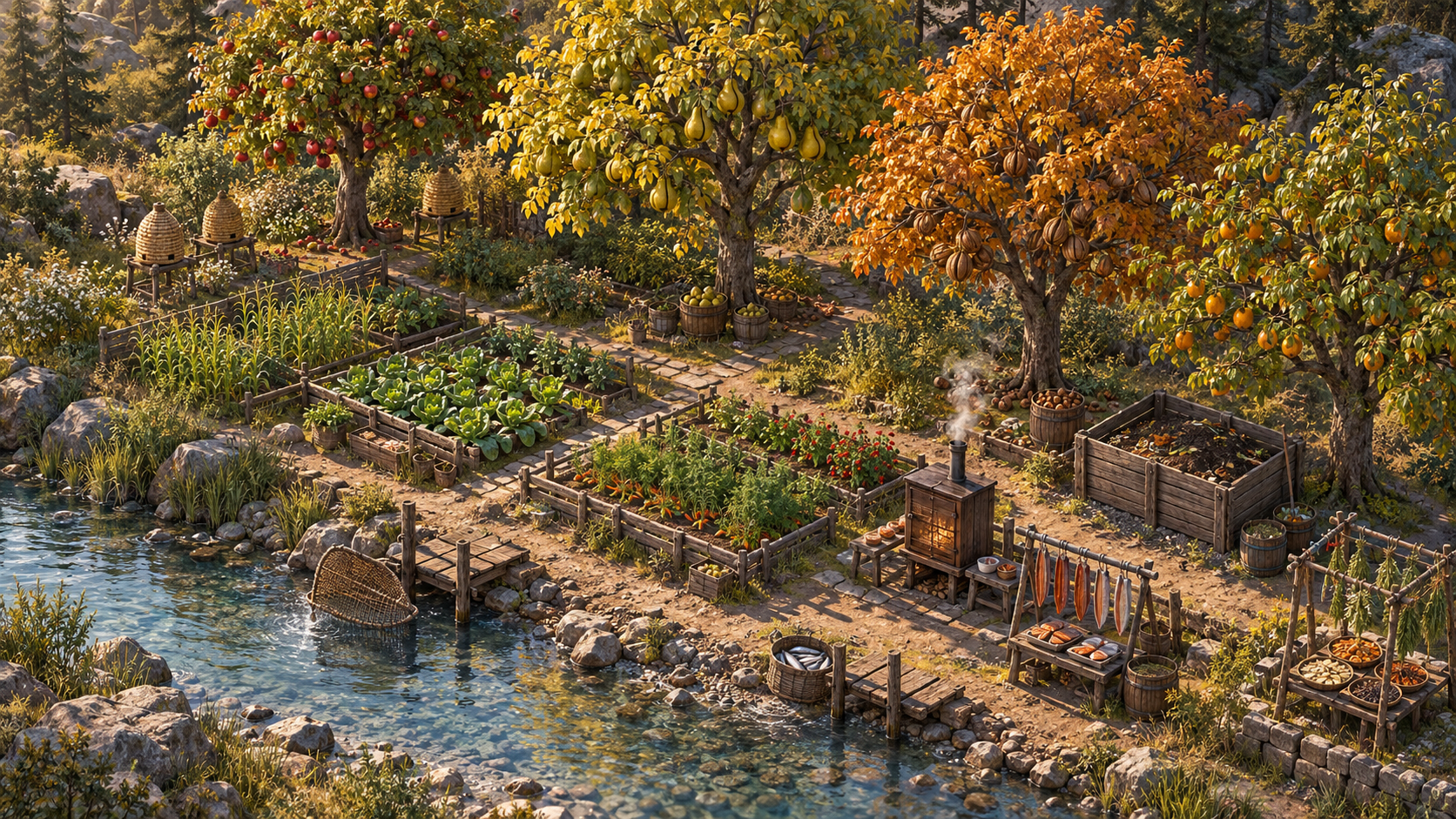
- Turn raw hides into leather at the tanning station and raw fibers into finished fabric at the appropriate loom.
- Load an eligible smoking or drying batch, then allow its saved processing timer to run.
- After Beer brewing, make rice mash and fill its matching fermentation barrel with Hauling enabled.
- Check temperature, storage filters and alcohol policies before diagnosing a stalled drink supply.
- Use the separate compost guide for rot and explicitly marked bone inputs.
Rules and limits
- Eligible racks use one-for-one output. Frogs, crayfish and crabs, including prepared meat, are excluded from both racks.
- Racks need five seconds of loading; processing then continues without a worker. Busy batches count toward target bills.
- Rice barrels take six days at ideal temperatures of 7-32 C; mash is not a finished alcoholic drink.
- Only the first calming attempt can start automatically. A second needs an explicit player order and a different helper, with a maximum of two attempts per break.
Four food priorities, one colony
Select a colonist, choose Food priority, then select a mode. The choice is saved for the colony; it is not a separate per-pawn policy.
| Choice | Effect |
|---|---|
| Native food choice | Default. Leaves the native food preference score unchanged. |
| Soonest spoilage | Adds preference for eligible prepared food closer to spoiling at its current temperature. |
| Small meals first | Adds preference for prepared foods with lower nutrition. This is not a smaller-stack selector. |
| Broth first | Adds preference for eligible prepared food whose definition or label identifies it as broth. |
Policies still decide what is eligible
The setting adjusts preference within normal food selection. Diets, food policies, reachability and danger checks still apply. It does not force an eating order or guarantee that one food always wins every comparison.
Baby/newborn feeding, baby food, raw food, drugs and food already rotting are excluded. Inventory-taking and caravan packing are excluded. Meal nutrition, hunger drain and allowed-food policies are unchanged.
A useful check
Put permitted broth and another prepared meal within reach. Select Broth first and let a hungry colonist choose food. Repeat with Native food choice. Check policies and access before treating a different choice as a defect.
Source: Source/FeedbackFeatures161.cs; BUILD_0.1.190.161.txt. The four labels are copied from the current implementation.
Medicine, furniture and clean work
Anti-nausea tablets and immunity forecasts
After Medicine Production, make four tablets at a drug lab from 2 herbal medicine and 1 neutroamine. One dose suppresses neglected-filth vomiting and food-poisoning vomiting, pain and capacity penalties for 12 game hours. It does not cure the illness, clean the room or improve immunity.
Disease/immunity warnings compare current estimated time to lethal severity with time to full immunity every 250 ticks, using a 6,000-tick margin. Yellow warnings can escalate to red danger. Colonists, colony prisoners and slaves on loaded maps are covered; caravan/world pawns are not. Forecasts change with care.
Eleven bone furniture pieces
Craft at the bonecarver’s bench, then install: three throne sizes, altar, dining table, chair, single bed, double bed, gold-trimmed double bed, Biotech crib and anatomical research skeleton. Beds/crib require Complex Furniture. Bedding takes the chosen material color; one dye recolors bedding after work finishes, while restoring the original color is free.
The research skeleton gives +5% research speed within three cells of a bench in the same room. Its medical proximity bonus is +5% tending/operation speed, not skill, surgery success or healing. Extra skeletons do not stack.
Food Rot and the Envoy Robe
The .146 R3/R4 companion fixes are integrated from .147 onward. Rot delivery takes priority over priority-area stain cleaning when eligible bins or storage exist. Keep Hauling enabled and rot/bins allowed and reachable. The robe uses Crafting, eligible fox crafters and its revised material filters; recreate or edit an old cloth-only bill when needed.
Sources: .144, .146 FIXED R3/R4, .147. Earlier manual descriptions are retained as reference; these later rules take precedence.
Earlier feature article
Open the detailed feature article for the changes, context and testing status.